


Regret Ms. Iyer
Sudha Subramanian
"I met “rejection” long after I started my love affair with words. Ever since, rejection has followed me like a shadow. And as far as I can remember, it has always hurt. Some stories face multiple NOs (twenty-five/thirty) from editors before they find homes. I wanted to write this piece as a reminder to myself (and everyone else) to never lose hope. If I have learned one thing from over three decades of writing, it is simply this: like with everything in life, we should sing to ourselves, ‘just keep swimming.’ "
Artwork by - Au Pied du Sinaï, Rejected Cover, 1897 | Henri de Toulouse-Lautrec

Regret Ms. Iyer
The year was 1988. An old movie played on TV while my head reeled under a heavy onset of allergy. I don’t remember the exact sequence of events but sometime later, I picked a cracked Reynolds ballpoint pen and wrote in the back of my laboratory record book. When I finished writing, I dreamt of buying something expensive from the money I would make by sending it to newspapers. Of course, the prose had to be typed in A4 size sheets, double line spaced and I had to squeeze out money for SASE (self addressed sealed envelope) from my pocket-money. Little did I know then that essay would never see the light of the day and my writing journey had taken off.
During the time when I was a student of journalism, I heard of a person named Regret Iyer. Regret Iyer, or Satyanarayana Iyer, was a writer who had amassed up to a hundred ‘regret slips’ and went on to nickname himself Regret Iyer. I had by then collected a few slips of my own and was having a dry run of sorts from everywhere - magazines, newspapers, poetry collections and the odd contest.
This is the tale of one such story. A story that has a record of twenty-four declines (my personal highest). What you will read here is a tale of victory. But behind this rosy picture of jubilation is a person who spent hours crafting words like a maniac, who found hope in the dimmest light and who believed in the story when nobody did.
In 2021, I took a leap of faith towards lit mag publication. I wanted change and my newspaper assignments were fewer and far in between. After spending hours on Twitter (now X), I came up with a list of magazines I would like to submit. One of the names was a mag that featured stories about a place. It could be a small spot, a bench, a tree, anything. Even before I knew what the story was, I knew where it would be set. As a tree-hugger, it could be nothing else. That is how a story with a banyan tree was born.
My first draft of the story was called ‘The Big Banyan Tree’. I wrote that in Jan 2023 with a total word count of 900 words. Below is my first draft. (For convenience and also since the opening is the most important aspect of any flash, I have copied the first two paragraphs of the piece)
Our relationship never turned out how we wanted it to be. Sometimes we wonder if it is because of how we met. We met on the first day of Ashada - the inauspicious month of Hindu calendar. You were on the tree - balancing your small foot on the branch right next to the large main trunk. I was nearby, seated on gunny rope hung to the thick wood, swinging with glee. As Manju, my friend, pushed me, I giggled with a shriek. You watched me with a thin smile, and wobbled. “Hey,” I screamed, “Careful,” I stuck my hand out when you fell on the hard surface below.
We ran, wanting to be of help. Your knees bore scratches, and your elbows had red marks but you looked at me with your deep brown eyes and set my heart on fire. I was only ten and you were twelve, the age that my mother warned me against speaking to boys. I didn’t believe my mother and I continued to visit the Big Banyan Tree because I liked to more than just feel my hair in the wind on a rope swing.
I was pumped when I finished drafting and dreamt of acceptance letters, congratulatory notes, BOTN noms. The following day, I started editing, believing in my heart, I had a masterpiece in my folder.
Although I wrote The Banyan Tree for my ‘dream mag’, I chose to submit it to an anthology I’ve been wanting to be part of (I won’t disclose the journals to protect privacy) in Feb 2023. Here’s the story in its entirety.
We met on the first day of Ashada, the inauspicious month of the Hindu calendar. Your arms latched onto the grooves, and your foot fumbled between the ridges of the giant trunk. You watched me swing with a thin smile and wobbled. “Careful,” I stuck my hand out when you fell on the hard surface below.
Your knees bore scratches, and your elbows had red marks, but your deep brown eyes set my heart on fire. I was ten, and you were twelve, the age my mother warned me against speaking to boys.
I continued to visit the Big Banyan Tree because I liked to do more than just swing or feel my hair in the wind. You led me along the lowest branch, and we sat with our legs dangling below. We gazed at the sky through the crack of the leaflets. I was twelve when my cheeks burned as my arms brushed against yours.
I soon noticed the first spurt of your mustache, where a tiny mole played hide and seek. We climbed the highest part of the tree and explored the nests tucked in the crook of its arms. We huddled behind the fresh burst of foliage as a hatchling struggled to fly off the nest. You crawled to the little one and untangled the lint from its feet. We clapped when it took its first flight and hugged as our hearts drummed in glee. I was fourteen, and we wondered what freedom could mean to us.
We craned our necks to find the lone eagle shedding sorrowful tears from the bough of the massive wooded life. “They are monogamous,” you said and explained how the large raptor would spend the rest of its life soaring the skies alone. I laced my fingers in yours, and we promised we would never part. I was sixteen, and we began to carve a heart with a sharp stone and filled in our initials.
We met secretly behind rooted pillars of the Banyan that stretched hundreds of miles. It gave us moments to feel our racing hearts, away from prying eyes.
“Banyans live hundreds of years,” you whispered and caressed my face with your fingers.
I was eighteen, and we sealed our partnership with a gentle kiss on the lips.
We promised we would meet again - on the first day of Ashada, three years later.
Alas, three became five, ten, and twenty.
We both stood a few feet apart, the silver brushing your forehead and the glint in your eyes. We gasped as the first dash of the axe seared through our hearts.
It was the only way to save the tree.
I longed to reach out, but we held our gaze as the one witness to our partnership gave way. It was slow and gentle as the massive pillar with the green roof, tipped, and tumbled, breaking our heart into two.
The birds sang, the bees buzzed, and we both stared at our broken hearts.
I chopped away nearly half of the earlier draft. The following week, I sent the same version to another magazine. Looking back, I cannot help but laugh at how naïve I was. The awkward sentence structures in paragraph three using ‘I’ twice, and the use of word ‘burn’ alongside the age, can be any editor’s nightmare. I wouldn’t accept my story. Needless to say, I received a gracious decline from both.
It was a sign. Something was amiss but my faith in the piece was intact. All I had to do was work around sentence structure and add some emotion.
I moved the dialogues to fresh lines.
-
The clunky third paragraph needed work. I removed the ‘because’ sentence.
-
The passive verb - noticed - didn’t add much to the beauty of the sentence.
-
I had to minimise the use of ‘we’ in the fifth paragraph. It cluttered the flow. Something more had to be done to break it open.
-
The paragraph about the bird was a disaster and I wondered how the readers would have laughed. As a birder, I had wanted the tiny detail but I also wanted to make it lyrical not a fact-checking documentary.
-
It was at this point that I realized how this flash lacked depth. It needed something more, and I knew exactly what it needed. So in the next draft, I added the bit about girls learning to string jasmine flowers, but I knew the ending was perfect - or so I thought.
It took me another week to toss over the words and craft. My next draft was better. Here’s the second half of the flash.
We met behind rooted pillars of the Banyan that stretched hundreds of miles. It gave us moments to feel our racing hearts, away from prying eyes. “Banyans live hundreds of years,” you whispered, caressing my face with your fingers. We sealed our partnership with a gentle kiss, promising to meet again three years later on the first day of Ashada. You went to the University while I counted the days with a mark on the bough. I had turned eighteen, the juncture when parents began to think of my marriage and horoscopes, letters flooded our house.
I was nineteen when Mother draped me in a fine silk saree before introducing me to my prospective groom but I could think of nothing but our meetings under the massive canopy.
When I arranged the stalks of the jasmine on a string and bound them together, under the watchful eyes of the boy, I felt your fingers twine into mine.
When I sang the old Kannada song you enjoy, and your eyes latched at my frame, I remembered nothing but the soft touch of your lips.
The tree, the branches, the leaves, the flowers, and the birds, ebbed in and out of the waves of nadaswaram as I garlanded a stranger on my wedding day.
And I carved more hearts with our initials and left messages on branches and props.
After forty years, we stand a few feet apart; the silver brushing your forehead, the mole dancing on your shaven lips, and watch the spectacle unfold with our hearts in our mouths.
The first dash of the axe sears our hearts.
It is the only way to save the tree — to clip the disease before it attacks the enormous expanse.
I long to reach out, but we hold our gaze as the one witness to our partnership gives way. It is slow and gentle as the massive pillar with the green roof tips and tumbles, breaking our hearts in two.
I am sixty, entering a new dawn with no mother or husband by my side but surrounded by sons, daughters, and grandkids.
The birds sang, the bees buzzed, and we stared at our broken hearts.
My fingers itch to carve a new heart, but you are long gone.
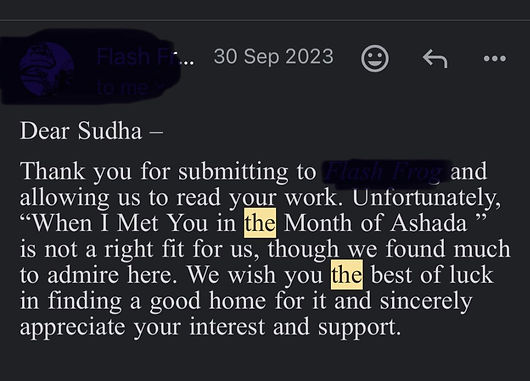
I saw promise. A lot of promise. It had to be simultaneous submissions. I made a list and shot off to nearly ten of them. In weeks to follow, I heard back from magazines with a polite NO. So, I subbed to more of them. Between April and July. I roughly sent another four magazines. My hope dwindled each time someone declined. And then, I saw some light. One particular editor wrote back a tiered rejection.
There. I had hit gold. The piece was nearly there but wasn’t crossing the line. It meant I wasn’t seeing something. I roped in a beta-reader. She pointed out a few things including a change in the title. “Like the film Dil Se,” she said, “maybe call it Under the Banyan Tree.” There was another factor she pointed out to. “What is nadaswaram?”
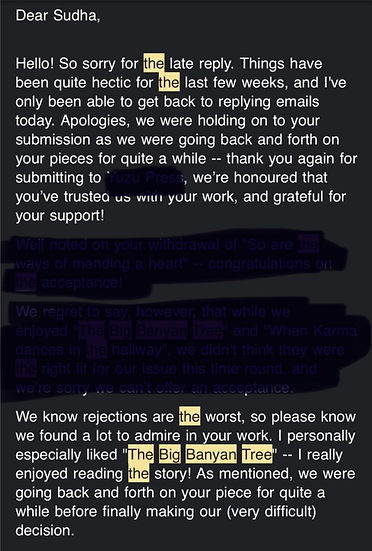
I have been a strong proponent of using local words. She hadn’t figured the word from context. But I decided to retain the word and I shot it off to another five magazines. In the meanwhile, I shared the story with a person who is my ‘good-luck charm’ in Dubai. She reviewed it and thought it worked. I was super confident and I waited for the congratulatory message all week. September had to start well. I hoped so. But in the first week of the month, I heard back from two magazines. And by the end of the month, all my hopes came crashing down. I couldn’t give up. “Remember the tiered rejection?” That's what my heart relentlessly hammered into me. Sometimes I shock myself with this kind of obstinate optimism.
“This can’t be happening!” I wrote to this friend who has a wise-head. “It is near perfect. Why then?”
“Let me take a look,” she wrote back.
It was another week before I heard back from her.
“Oh! You have to change that title!” She wrote. “Under the Banyan Tree, sounds like a nursery rhyme and The Big Banyan Tree is more like a title of a children’s book”
"Really?” I asked.
“What is nadaswaram anyway?” And it was the second time someone had asked the question.
When two people point to the same problem, you must change it.
In September 2023, I was back on the desk with the story. I had to change the word. I also had to make a few minor edits. Then the big task of the title was still working in my head.
“Do you like - When I Met You in the month of Ashada?” I typed into the chat box.
“I love it!” She replied in an instant.
All the problems had been solved. I formatted and waited. I scanned X for sub-calls and sent it to more magazines. There were more personal declines.
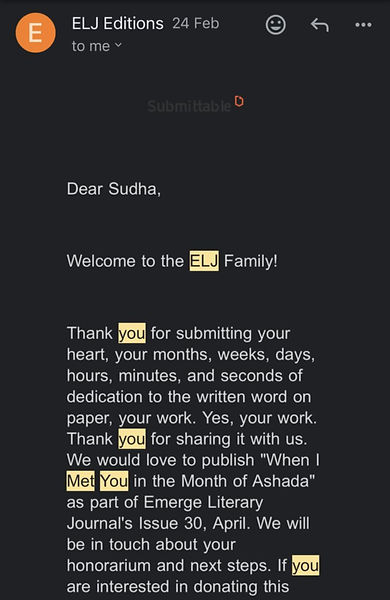
On a cold February morning in 2024, I heard back from the editor. Believe it or not, she asked for one more change in sentence structure.
https://emergeliteraryjournal.com/when-i-met-you-in-the-month-of-ashada/
After twenty-four rejections, this story found a home, with a payment of 15 dollars. Although the money doesn’t compensate for the hours put in, it seemed worthwhile. Am I happy about it? Not all stories have a fancy home, not all of them brave the heat and the wrath of the delete button on the keyboard. At the moment, a story very close to my heart is still scouring the net for a home. It was born in July 2023. It has been through two beta and numerous edits. It has got two tiered rejections from very good magazines and is currently at rejection number 9. Am I going to give up? You think? If anything, I have earned the title of Ms Regret Iyer. And, my rejection count is little more than 500 over two decades of freelancing and writing. And if you are wondering if it stops hurting with all this thick skin, I have to say, it doesn’t. Rejections hurt because every creation is born from the heart and every NO dents, scrapes, stings. We cannot always brush the pain aside. What we can do, is to hold the story closer to heart and nurture it some more.
What I have learnt from rejections :-
-
You can never get used to it. I have gotten a variety of advice from young, old, experienced, inexperienced, non-writers, non-readers, readers, and writers about how to deal with rejection, what to call it, what not to call it and so on. But over the years, I have come to accept a simple truth. Rejection Hurts. The idea is not to NOT SULK. Sulk. Cry. Go through the motions. But once you are done, wear a thick coat and sit with a lens to deal with the story.
-
Never Ever tell another writer - “Even I got rejected.” I am not exclusive. I am part of the big subset of the superset of humankind.
-
No matter how good the writing is - someone out there is going to dislike it. That is the way of life. It hurts. It is personal. But remember that someone also loves it.
-
If the story gets declined, continue to work on it and sub. Remember that story that was shown the door by over fifteen magazines, but won an award in a contest?
-
Subbing is a game of chances. Some may call it a gamble. But if we are playing it, there is going to be a lot of pain, some gain. But for that teeny moment of joy, we only have to continue to sub.



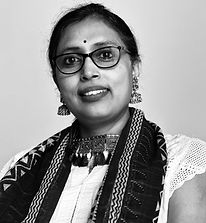
Sudha Subramanian is an Indian writer living in Dubai. She was a columnist at Gulf News for fifteen years. Sudha loves a good chai, enjoys humming old Hindi and Kannada songs and dreams of all things big and small. She is a tree hugger and an amateur birder.


Ink & Quill
Collective
© The Ink & Quill Collective 2025. All rights reserved.
FOLLOW US ON


Or drop us an email at -
theinkandquillcollective@gmail.com
inkquillcollective@arijitnandi.com